I Went to a Sleep Module and Came Back with a New Way of Thinking: Inside RC4’s Unique Curriculum
I Went to a Sleep Module and Came Back with a New Way of Thinking: Inside RC4’s Unique Curriculum
Written by Xilu Wang
It's a Tuesday evening, and instead of slumped shoulders and furrowed brows, our classroom looks more like a quiet studio. Yoga mats line the floor. Students lie still, eyes closed, breathing slowly as a soft guiding voice plays from the speaker at the front of the room.
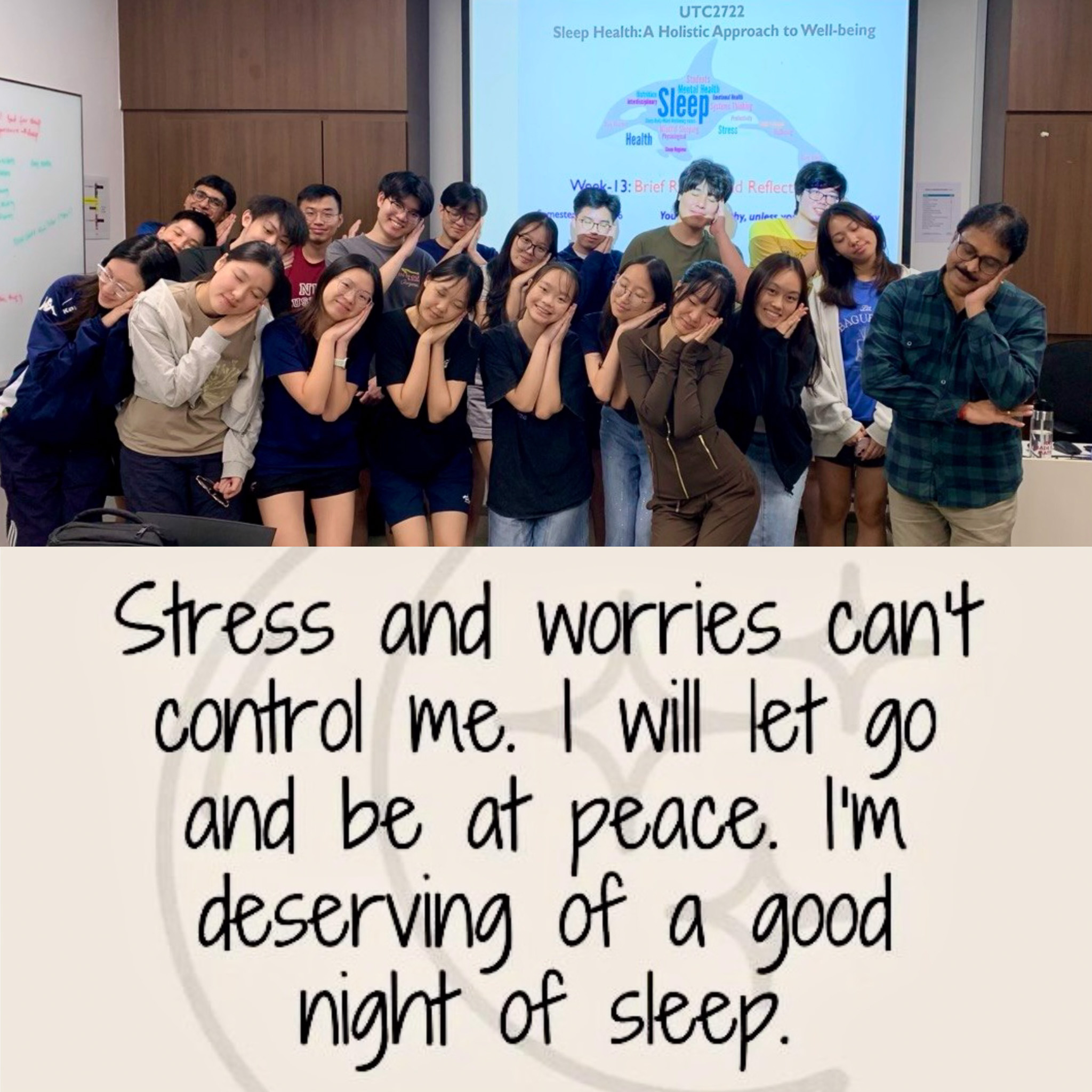
This is not a wellness retreat. It is part of a weekly module called "Sleep Health: A Holistic Approach to Well-being"—one of the most unexpectedly transformative modules I have taken at RC4. Led by Dr. Bellam, this course does not teach sleep as a simple matter of "get eight hours." Instead, it treats sleep as what RC4 teaches all its students to see: a system.
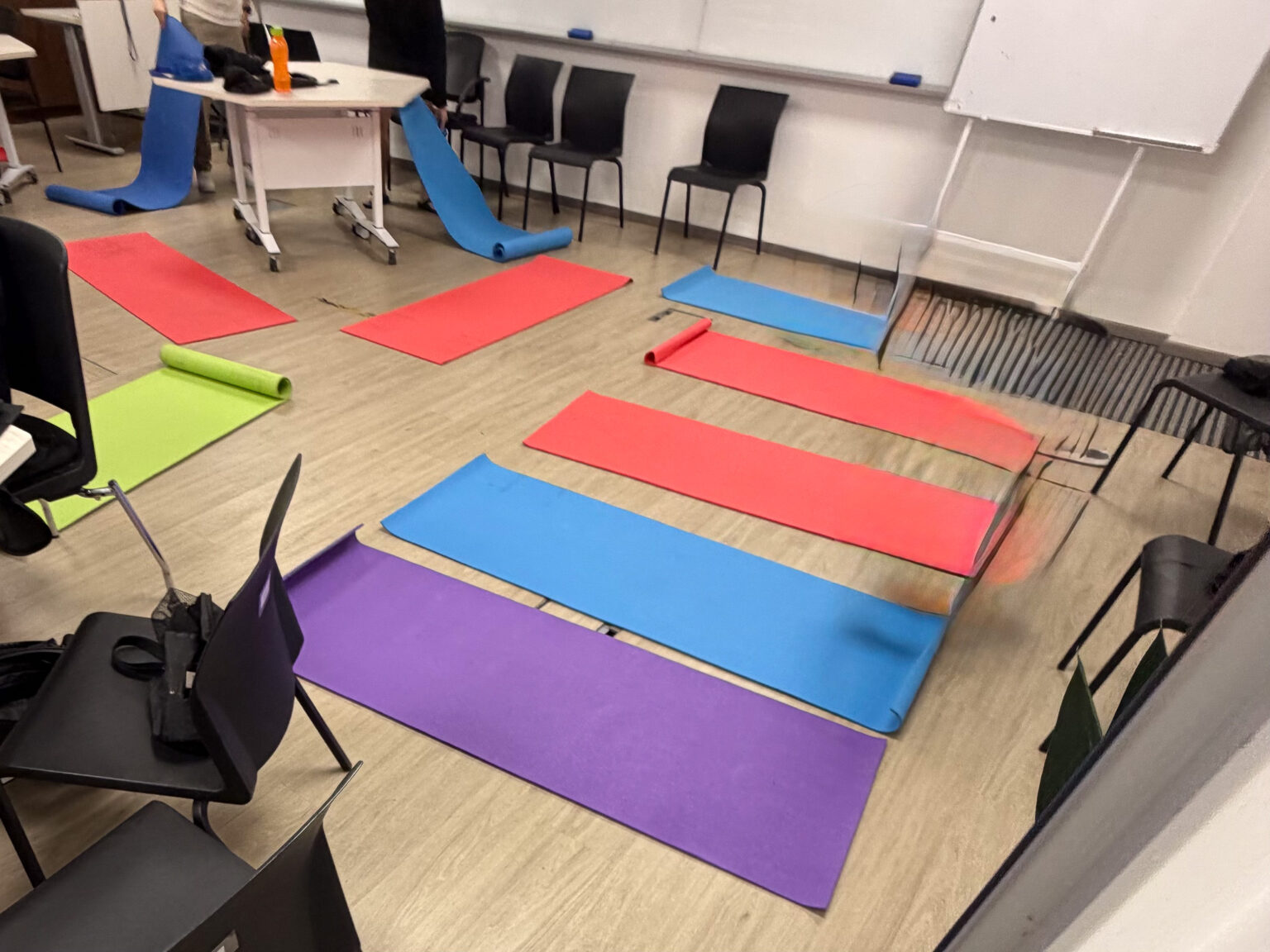
Students lining Yoga mats in the classroom to prepare for the meditation exercise.
At first glance, a course about sleep might seem narrow. But that is precisely the point. RC4’s entire curriculum is built around a single powerful idea: systems thinking. Unlike the linear thinking we are often used to — where A causes B causes C — systems thinking looks for loops, connections, delays, and unintended consequences. It asks not just "What went wrong?" but "What keeps this problem stuck?" and "Where can a small change create a big shift?"
Across RC4, students learn to draw Causal Loop Diagrams, or CLDs — visual maps of feedback loops that reveal hidden relationships. One module maps the spread of infectious diseases using stock-and-flow models. Another traces energy security in Singapore, examining how weather, global prices, and local policy create ripple effects across the island. A third unpacks the fresh food supply chain — why a vegetable shortage in Malaysia affects hawker centre prices within days. The topics are wildly diverse, from markets in Singapore to diet and metabolic health. But the method is unified: see the system first.
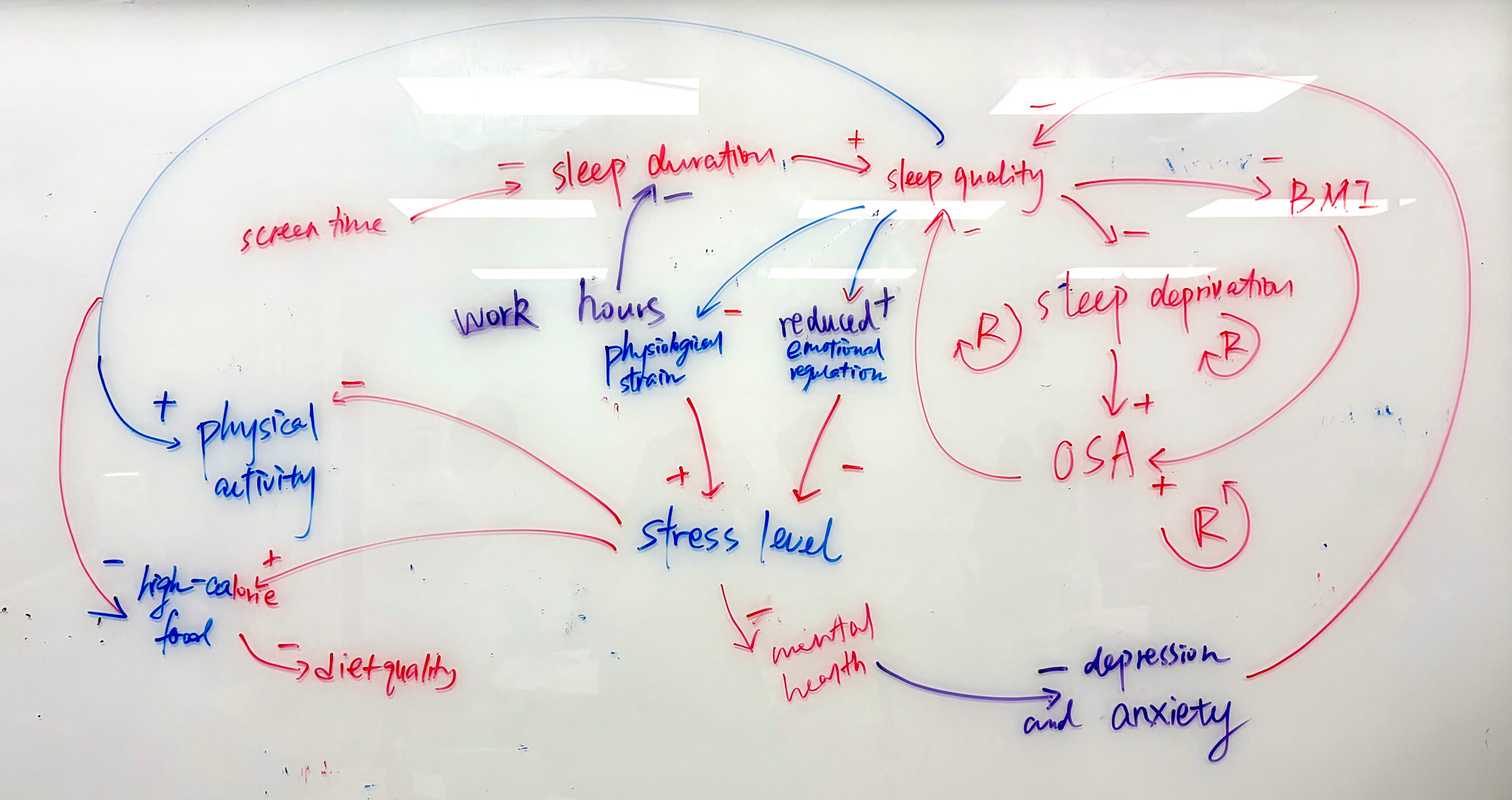
A CLD diagram drawn by UTC2722 students during class.
My module with Dr. Bellam applies this lens to the most intimate system of all — the one inside our own bodies. Sleep, I have learned, is not an isolated event. It is the product of overlapping loops: biological rhythms, behavioural habits, environmental conditions, and psychological states. The course uses a variety of activities to deepen this understanding. Beyond the meditation exercise — which taught us that ten minutes of guided breathing can measurably lower our arousal state before bed — we also keep weekly individual sleep diaries. For Viona (Year 2 Data Science and Analytics), recording her bedtime, wake time, phone use, caffeine intake, and satisfaction rate of each sleep felt a bit tedious at first. “But after three weeks”, she recalled, “the patterns became undeniable. I could see exactly which habits were pushing my sleep later, and which small changes actually made a difference.”
We also have guest lectures from professors in psychology, neuroscience, and public health, each sharing from their own field and adding new lenses to how sleep connects to memory, metabolism, mental health, and academic performances.
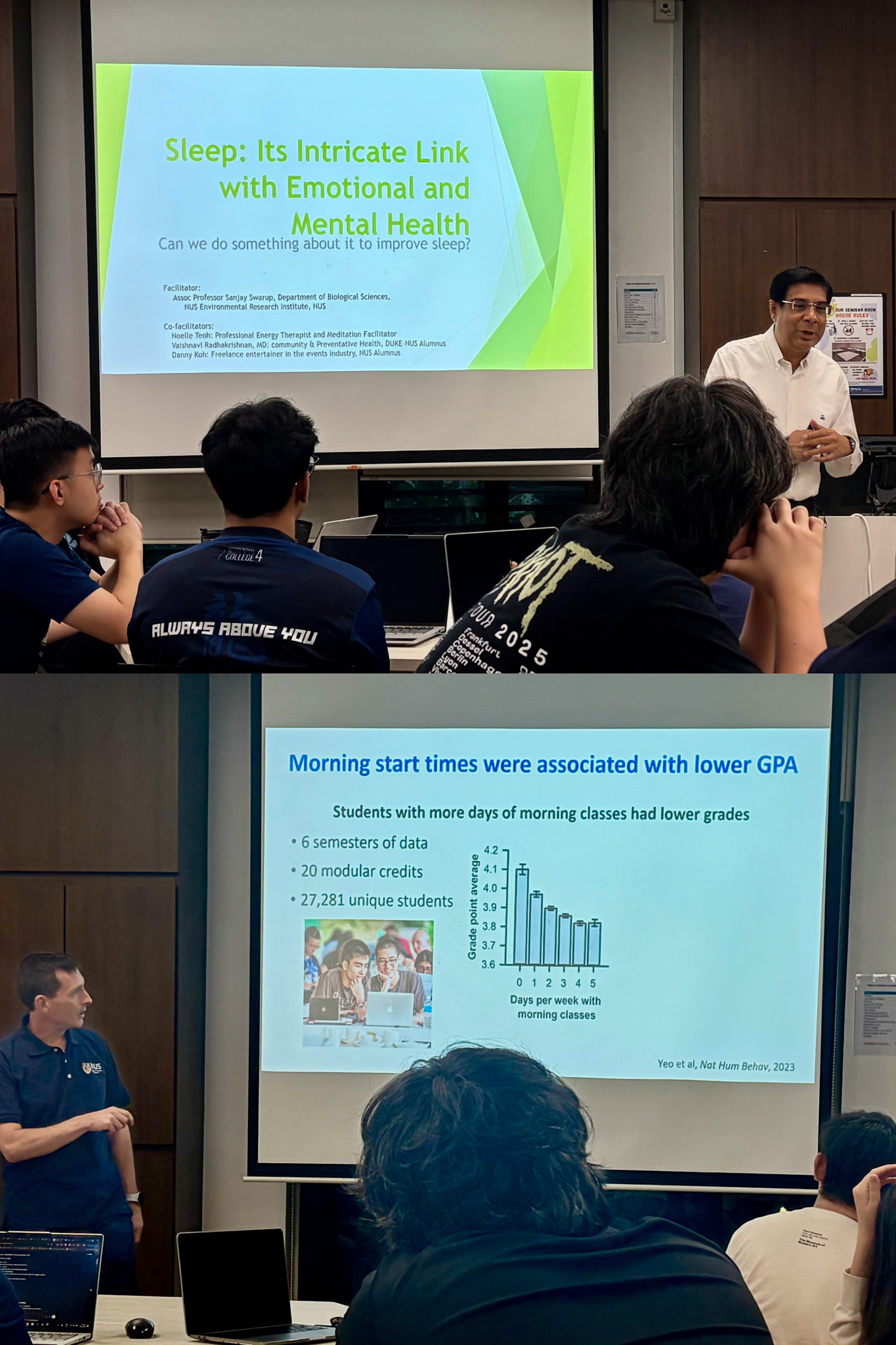
Guest lectures about sleep health and its significance.
To delve deeper into the intricate connections between sleep and behaviour, we had a memorable demo class on polysomnography, or PSG — the gold standard for clinical sleep studies. A student volunteer was invited to sit at the front of the room while instructors carefully attached electrodes to her scalp to measure brain activity. As the student volunteer moved around, the measured brain waves displayed on the screen changed accordingly. Watching a classmate transform into what looked like a friendly cyborg made the science unforgettable. For a moment, the abstract concept of "sleep measurement" became tangible, visible, and even a little funny — but deeply real.
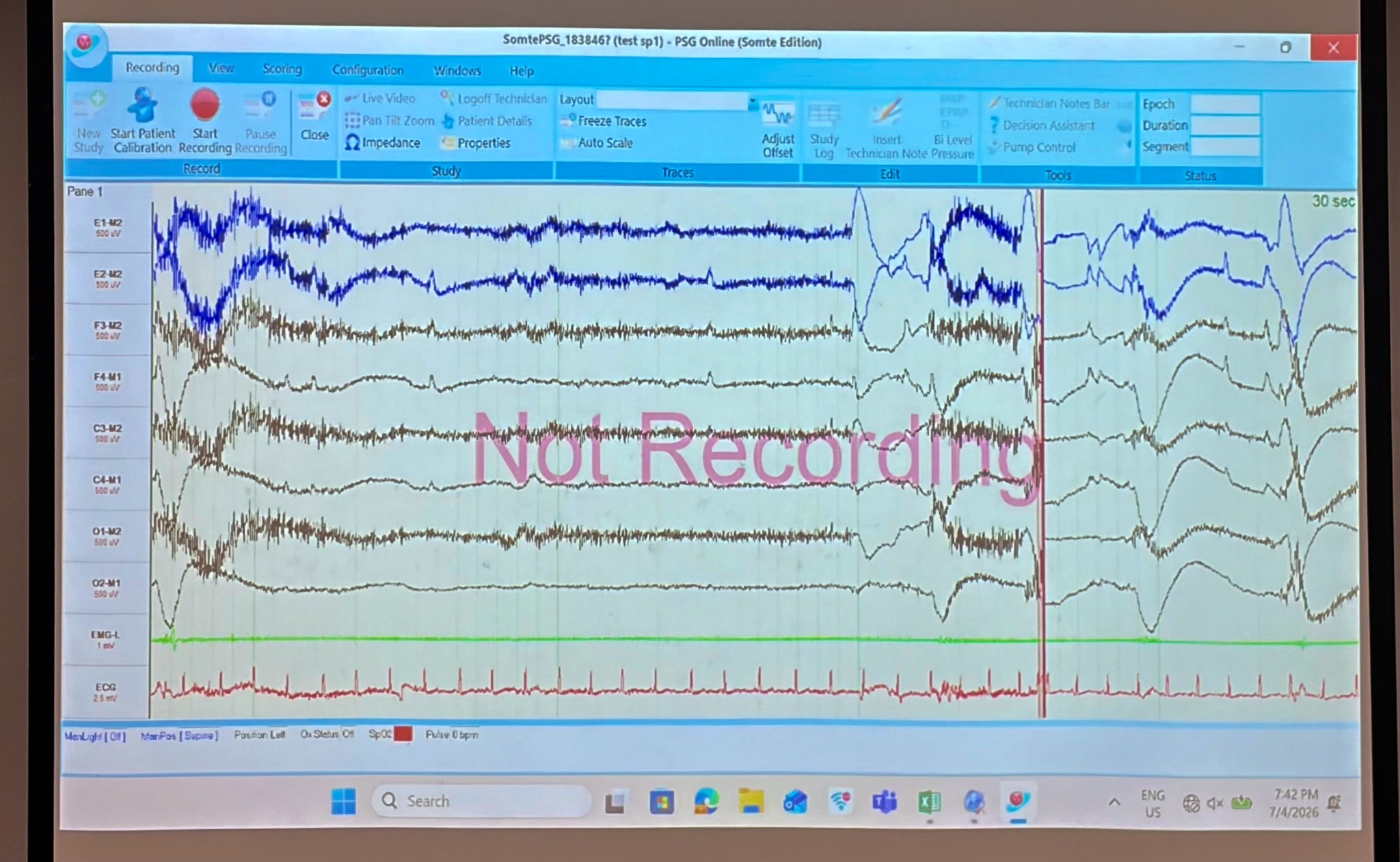
Measured brain activity of the student volunteer by PSG.
And yet, as memorable as that session was, the real lesson of RC4 extends far beyond any single demo or diagram. What stays with us, long after the semester ends, is how RC4's comprehensive and interactive learning environment lets system thinking travel with us beyond any single classroom. A student learning about sleep health and a student mapping energy problems in Singapore speak the same language: feedback loops, delays, leverage points, unintended consequences. Whether the topic is infectious disease dynamics or the psychology of diet and culture, the underlying skill is the same. We learn not what to think, but how to see.
Indeed, these courses are not just academic requirements. They are a form of intellectual training for life — because life, like sleep health, is not a straight line. It is a web of loops. And once we learn to see the loops, we can start to change them.
As the classroom empties and the chatter fades, what lingers isn't just the facts from the lecture, but the quiet shift in perspective. Perhaps that is what makes RC4's academic culture truly special — it doesn't just fill our minds with knowledge. It changes the way we see ourselves, our habits, and the hidden systems that shape every part of our day.